
Last year I ruminated a bit about Halloween Horror Nights after experiencing the event, and I thought this year I’d try to do the same. As before I’m going to avoid engaging in the tradition of house rankings. I think scaling the houses objectively from “best” to “worst” is saddled with all kinds of problems — are you measuring production value? “Scariness,” which is undeniably subjective? Storytelling? Vibes? There are just too many vectors to look at houses with, and I’d rather just interrogate what they’re each doing and whether they’re successful at it.
As usual I’ve tried to embed links to walk throughs of the houses in an effort to help you understand what the heck I’m even talking about, but know that a shaky blurry camera is a poor substitute for experiencing this kind of thing in person. There are details the camera can’t capture — smells, the feel of stuff-in-face scraping by your cheeks, small environmental details in the dark, and at least one vibrating floor are all lost this way. If you have the opportunity to hit up the event — or any haunt, including your local haunts — I’d recommend it. Online clips can’t do this sort of thing justice any more than watching a video of a rollercoaster does. Go find a spooky time to have this fall. You’ve earned it.
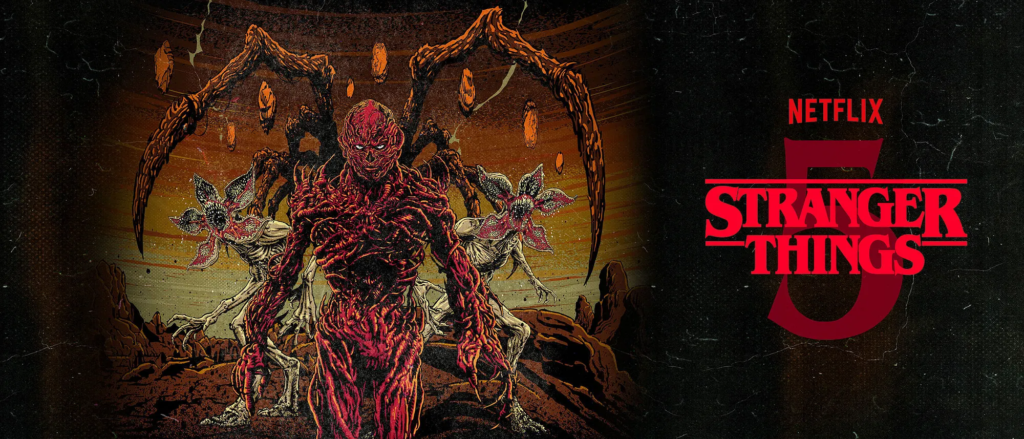
Much like The Walking Dead’s final house, this swan song to an oft-recurring IP at the event is surprisingly solid. Bizarrely so, really — Stranger Things 5 might not have fully soured people on the series the way the final episodes of Game of Thrones did, but it certainly wasn’t the ending most people were hoping for. So in a way the house is doing more for the show than it arguably deserves.
If I had to sum up the house in one word, I’d say it’s “effective.” It’s effective at delivering some good jumps and it’s effective at hitting some of the beats from the final season. But it never congeals into anything cohesive? My spouse put it best: “it’s a really good house that stops every other room to remind you it’s about Stranger Things.”

And those breaks in the scares aren’t even bad! They’re impressive! There’s a scene where Will (played by a live actor) uses his newfound psychic abilities to crumple a full-size, full-body demogorgon animatronic whose limbs crack and split! You walk between them, and seeing a levitating 10 foot tall Demogorgon is a sight to behold. There’s a scene in the Upside Down with the kids (mannequins with their backs turned so it looks okay in the dark) looking out at the Mind-Flayer in the distance. Then as you turn a corner a giant screen shows the Mind-Flayer’s toothy mouth growling down at you! These scenes aren’t scary, but they’re impressive set pieces that really say “wow, I’m in Stranger Things Season 5, a passable conclusion to a story that took too long to tell!” And I’m only being half-sarcastic here; they really are impressive in size, bespoke props, and special effects.

But they’re not scary. The scares are all in scenes that could be from almost anywhere — someone’s kitchen, some lab, some laundromat, some abstract Vecna-tentacle hallway, some corner of a cave in the Upside Down. What those rooms lack in gravitas or iconography they make up for by being effective in delivering what they want to deliver with clever distractions and misdirects opening guests up to scares from unexpected directions. The kitchen scene has Nancy Wheeler burst in with a knife and as you approach from the previous room you think that’s the scare. But there’s secretly a demogorgon that gets triggered from behind guests entering the room, which is what Nancy is reacting to. There’s a vent in the ceiling where an animatronic of a fully-flowered demogorgon’s face is trying to break through, which you can’t help but look at… which sets you up for a great scare from the demogorgon actor hiding in the doorway next to it.

These rooms are also mostly where you’ll find Vecna, and it’s actually kind of hilarious how The Big Bad of the series is basically treated with less reverence than the demogorgons and Mind Flayer. They just kind of put him in a few random corners to stick his giant clawed hand out in front of unsuspecting guests. Then you find his smashed corpse at the end of the house because that’s what happens at the end of the season. He doesn’t really have a setpiece room to himself; he’s relegated to an also-ran in his own franchise. It’s so disrespectful and anti-climactic to the character that it becomes genuinely funny, especially given how much Vecna is plastered all over the marketing and merchandise.

I went into this house with really low expectations. It’s the fourth time we’ve done this, and I didn’t think there was much left to wring from it. And there isn’t, really. We’ve been jumped by demogorgons in previous houses, we’ve had live actors stick out their arm and pretend to scream as they break apart demogorgons, we’ve had Stranger Things houses where a Giant Thing Looms Above You. Nothing here is really all that new. But there are worse ways to go out than with some effective scares and some memorable if derivative setpieces. I walked out having had a really good time despite my feelings on the property, and I think that’s the mark of a solid house.

This is such a weird goddamned house.
Bear with me, because this is going to take some explaining of a bunch of nerd shit. For those who don’t follow the event much, Halloween Horror Nights has the concept of “icons.” I don’t have time to get into the history of this (if you’re curious, Sam at Expedition Theme Park has a rather extensive history of the whole event) but the short version is that they are the recurring original characters beloved by fans that “headline” each event (i.e., are put on all the merchandise and are used in all the commercials). They’re part mascot and part ring leaders of the circus; the characters that set the tone and general ‘theme’ of the year’s event. And this year (an anniversary year) they’ve brought back two fan favorites: Jack the Clown and Dr. Oddfellow.
Jack the Clown is the icon in the way that Bugs Bunny is the Looney Tunes character — the mascot of mascots, the fan favorite, and easily the most famous and recognizable of a whole gaggle of weirdos. He’s been around since 2000 and tends to show up on anniversary years (and also headlines his own show in the year-round Las Vegas HHN attraction). Along the way he’s accrued a lot of capital-L Lore and loosely implied backstory that exists primarily as lost media ARG marketing content, fan wikis, and half-remembered house walk throughs of 20 years ago. Among that Lore was that Jack was originally Jack Schmidt, a deranged circus clown in the 1920s who couldn’t stop killing people as his carnival traveled across the country. This forced the circus’ corrupt owner to kill him to stop attracting the police to his circus’ other crimes (this means Jack is, technically a ghost clown, or perhaps a spiritual manifestation of Jack Schmidt’s evil, or some other not-quite-a-dead-clown entity).
The circus owner who killed him was named Dr. Oddfellow. But he didn’t materialize as an actual character until 2023, the year he became an icon and got his own Lore driven backstory. In addition to using the traveling circus as a front for a while, he was an adventurer and conman obsessed with discovering immortality at the turn of the 20th century. He’s part carnival barker, part pith hat wearing colonialist adventurer, part semi-immortal being as a consequence of bringing the manifestations of the zodiac (Surreal and Sinister, two other icons with their own backstory) under his control. His whole thing is a magical green skull he found on his adventures that opened the world of the Zodiac to him.
Jack & Oddfellow: Chaos and Control is a haunted house that tries to convey much of that backstory while also moving the story of these characters forward in one of the biggest, most effects-heavy haunted houses Universal has ever put on. It is a maximalist house, packed with story beats and technical tricks and narrative ambitions, and all of them screaming for your attention at all times at the expense of the others. It’s a lovely, beautiful, fanservice-packed pile of Too Much.

The first half of the house painstakingly explains the extant Lore — the carnival, the murders, Oddfellow killing Jack and then stuffing him in a box to torture (Jack being in a box is a longstanding hallmark of the character because… well, Jack in the Box is too tempting of a reference to pass up, I guess). Then we enter the world of the box (here called the Oddverse) and things get much more abstract and weird.

We see how Oddfellow tortured Jack in his own private blacklight Clown Hell, with all sorts of circus themed monstrosities tearing him apart over and over. Oddfellow occasionally steps in to oversee and mock Jack as the entities of the Oddverse slowly feed on him. And, ultimately, Jack is destroyed. We walk through a hallway dotted with particles of light where we see him fully deconstructed, his clothes and clown makeup splintered into a bunch of empty fragments on the walls. An uncertain amount of time passes.

But then Jack’s theme song plays. He isn’t fully gone, not yet. And in the next scene we see him manage to reconstruct himself (albeit with some errors) and a version of the Shadybrook Asylum (an HHN staple location that has been used in lots of houses, Jack related and not. Again, there’s lots of Lore here in that fanwiki kind of way). He leaps out onto the scene, only mostly reassembled, and announces that Jack is Back.

Jack begins asserting his domination over Oddfellow’s Oddverse, sending recreations of his old loyal Shadybrook inmates after the carnival barker. Jack even manages to kill him a few times (he’s immortal, so it’s okay, he gets better). There’s a great room here with a tilted floor that pushes you towards a padded wall a clown will jump out of. From here the gloves are off, with blacklight clown junk and blacklight zodiac junk bumping into one another in a cacophony of noise and imagery where I’m sure there were some good scares if you could hear or see them. I don’t mean to be snide, but the house kind of gets lost in the sauce here — it’s all boo holes and black lights and clowns of various levels of demonic alteration.

But then — and this is where the house really loses me — in the next room they’re besties. They realize that fighting solves nothing and the ✨power of friendship✨is the best way to ensure they both get what they want out of the Oddverse, because working together they can terrorize more people than just one another. Whenever and however they decided this isn’t really shown. They’re just suddenly on top of a giant green skull talking about how they’re allies now.
And like… I mean, these are supposed to be horror icons. The ringleaders. The most evil and malevolent beings Horror Nights has to offer. This should be an extremely uncomfortable detente; a fragile bargain where they both expect the other to betray them but are willing to go along with it as long as their powers grow. But no, it’s played completely straight. They finish each other’s sentences and executions. They’re ride or die besties now.
My spouse realized it after we went through: this is an enemies to lovers haunted house featuring the headliners of Halloween Horror Nights. It’s the weirdest fuckin’ thing.

To be clear, all of this is conveyed with some extremely impressive and expensive special effects. The summoning of Shadybrook is jaw-dropping, but even minor effects are employed really well. We have Pepper’s Ghost effects where Jack the Clown appears in a mirror over Jack Schmidt’s face. We have screens on top of a glowing split-open skull that feature full size Jack and Oddfellow characters yelling down at you. When we get pulled into the Oddverse there’s a classic vortex tunnel where the sides of the tunnel aren’t just rotating cloth but a full cylinder of LCD screens intertwining Jack’s costume with Oddfellow’s energies. It is an undeniably expensive house.

But it fails to convey the narrative it has invested so much of itself in telling. It sets up Jack and Oddfellow’s antagonistic relationship, then it sort of yadda-yadda-yaddas over to them being besties now. The house spends tremendous energy conveying the exposition for the story only to skip the actual story part. And worse, it can’t even commit to them being in love!
Still, if you want a drop-dead spared-no-expense gorgeous enemies-to-lovers house, this is fantastic. Just don’t go in expecting anything to really make sense.

Sinners was always going to be a tough film to adapt to a haunted house. For one thing, it suffers from The Exorcist Problem — all of the scary stuff happens in one place. Club Juke is unbelievably cool, but it’s basically a large barn with a few closets. And since the haunt can’t be made out of multiple instances of the big dance floor (both because of spacial limitations and the fact that monsters jumping at you from far away is ineffective) you just know most of the house is going to be a series of tight wooden corridors where side conversations were had in the film.
The other problem is that there’s not much to draw from, scare-wise. Sinners is a two hour and seventeen minute movie, but the actual vampire attacks comprise maybe forty-five minutes of the runtime? There aren’t that many iconic scenes to adapt that work in a haunted house. I mean, I love the scene where Cornbread asks to be invited back in to Club Juke — it’s at once tense and comedic — but how do you have people conga-line through that?
Third is the problem of racial subtext, which Horror Nights has always had a problem with (but that’s an essay for another day). Who gets into Club Juke is kind of a Big Deal, thematically, and turning it into a walk-through haunted house kind of makes that awkward. The movie itself is fundamentally, explicitly, and inexorably about race, capital, and art. These are not things a jumpscare maze is particularly good at exploring and if anything is likely to bungle.
The Sinners house has solutions for the first problem, but doesn’t really have any answers for the other two. They solve the redundant scenery problem by adding a cold open that isn’t really in the movie: we arrive at the Clarksdale train station after dark and hear the Smokestack twins talk about their intention to open a slammin’ juke joint later that evening. We then make our way to the home of Joan and Bert — the two folks who were unfortunate enough to let vampire Remmick into their house as he was on the run. There’s a delightfully creepy recreation of the room where Joan finds Bert dead: his body is on the floor while a rocking chair sways back and forth on its own and, unseen, Remmick soothes you by saying “Aw, he’s just restin’.” I love when HHN leans into quieter moments, which is something it isn’t easy for them to do.

After that, though, we walk straight into Club Juke and enter the dance hall. Sammy is on stage, playing the tune that will summon the devil while shadows of the dancing crowd flickers across the walls above him. Around him the walls of Club Juke burn bright in an attempt to adapt a cinematic metaphor and… I’m not sure it works? In the film Club Juke is burning as a visual shorthand for lots of reasons — to display how it’s a beacon to summon the vampires, to establish the passion and power of the music, to highlight Sammy’s skill as he literally ‘burns down the joint’ with his set. As a room in a haunted house, setting Club Juke on fire… is probably just confusing to people who haven’t seen the film. It’s nice enough, as set pieces go, but I’m a little confused by it.

But in Hollywood they have a different solution (for the record, I didn’t attend the event in California, but I do compare the houses when I can). Their house opens with this scene, and has the line double-back on itself rather than cutting straight through. This fills the space with people to help it feel more alive and like a dance floor instead of a big theme park set piece. They also turned the walls of Club Juke into screens that, as Sammy plays, will summon the spirits of similarly inspired musicians of the past and future just as his song did in the film. All the screens have a glossy sheen that gives away the illusion they’re really part of the walls, but it feels like a small price to pay to capture the scene’s intent a million times better. The dance floor is alive, Club Juke’s slammin’, and Sammy’s music is so good it’s summoning not only the past and future but other things as well. In contrast our scene has… some cool ember effects.

After that is the scene where vampire Mary, having been discovered killing Stack, announces to the living: “We’re gonna kill every last one of you.”
And like.
Look, in the movie that line has weight. Mary is white-passing, but she’s family. She loves and has history with the people in Club Juke, and they love her. The racial subtext of a white woman telling a room full of Black folks that “we are gonna kill every last one of you” is impossible to ignore. That it would come out of her mouth of all mouths is genuinely shocking. It conveys this is not Mary just as much as the act of killing Stack in the first place. Who is saying these words and to who are a fundamental part of the horror of the scene.
And this house saps that line of all of its weight by making it a spooky haunt threat. “OooO! We’re gonna kill y’all! We’s gonna getcha! OooO!” It’s not aimed at the patrons of Club Juke; it’s aimed at the haunted house guests. It’s tacky on its own, but the context being stripped away makes it leave a bad taste in one’s mouth.

Then there’s the brawl, which is a pretty huge disappointment. The scene is the crescendo of the action in the film, full of blood sprays and gunshots and impalings and even a bit of burning flesh. Here it is reduced to a room mostly full of mannequins as a single Sammy actor swings a prop shotgun around. There simply isn’t enough movement happening; it feels dead (and not in the fun spooky sense). It needed a good wet bloodspray of water as Annie stabs a vampire mannequin, or Smoke and Sammy saving one another with some of the movie’s more ridiculous gun-fu moves, or something.
Then we head outside, towards the dawn. There’s a good Cornbread scare here (though why it’s here and not towards the entrance where Cornbread spends pretty much the whole film, I have no idea). And the dawn’s light is actually much more impressive here than it was in last year’s Fallout house. As the house closes, we see a handful of Remmicks. There’s a flying Remmick where an actor springs at you and is pulled back at the last minute with a bungee cord, a half-transformed Remmick being stabbed by Smoke, and a fully transformed Remmick with Sammy’s guitar stuck in his head. It’s a solid few scares to end on, and if nothing else it’s a more dignified end to a house’s villain than Vecna got.

And then the house is over. Taken as a whole, the house is more or less about what I expected. Sinners is a great movie that lacks a lot of the things necessary to adapt it into a even a good haunted house. That’s not to say they didn’t try. There’s tremendous effort on display, and a loving recreation of specific scenes and what iconography there was to adapt. Pausing videos lookig for screenshots, I saw they are actually making the actors wear red contacts — an incredibly, almost detrimentally subtle touch (Hollywood’s house dangles small LEDs hung from their eyebrows to achieve a more literal glowing eye effect). There’s some good scares here, some good ideas, and simply walking around inside the world of a movie that good is itself a fun experience.
But at the end of the day, you’re adapting material that’s fundamentally incompatible with the broad strokes and emotional storytelling you need to make a good haunted house. If you wanted to make a good haunted house you’d need something a little baser, a little less cerebral and thematically dense, a little bit more genre-focused and trashy…

Hellraiser is exactly the house you think it is.
The first three films in the Hellraiser franchise (which is what the house is based on) are already pretty much haunted houses themselves. They’re real big on iconography and gore and tone and using all of those to gesture broadly at themes but they’re also basically nonsense plots where things happen because it’d be cool if they did. That does not make for a particularly great trilogy of films. But it does lay the groundwork for a really enjoyable haunted house.

The Hellraiser Haunted House at HHN (how’s that for assonance?) makes the wise choice to avoid retelling the story but instead doing a pastiche of scenes from all three films. We’re not following Kristy or Uncle Frank or Hellraiser 3’s Joey, and we’re thankfully not following Elliott Spencer’s fall and resurrection as Pinhead for a whole house. Instead we’re just guided by the Lament Configuration (which you enter a giant version of early in the house) into various scenes of Hell.
They play all the hits. Bloody skinless corpses. “Help me I am in Hell.” Decrepit hallways bathed in blue light and fog with chains draped all over the place. Beloved lines like “We Have Such Sights to Show You” and “Your Suffering Will Be Legendary Even In Hell” are played (or at least partially played — for some reason Universal chose to cut the “even in Hell” bit, which of course means “Jesus Wept” was also a no-go). All four classic Cenobites make multiple appearances so fans of Chatterer, Butterball, and (ugh) “Female Cenobite” will have fun spotting their favorites as they jump out at you. I am a little sad we didn’t get the ridiculous Cenobites from Hellraiser III like CD Head, but that would have clashed with the serious tone the house is going for.

But in addition to the meat-and-potatoes stuff there are a lot of nice, thoughtful touches too. One room features a special effect that lets you look out onto The Leviathan lording over the greater planes of Hell from a crack in one of the walls, and it’s a surprisingly effective illusion that sold the sheer scope the place is supposed to have. It gives the narrow stone corridors a much needed sense of place while also letting you get a cameo from one of the weirder and more abstract sights from the franchise you’d never expect to fit into a haunted house; I love it dearly.

They even manage to cover Elliott Spencer’s transformation into Pinhead. You round a corner to find the Spencer sitting in the corner of a World War 1 trench, Lament Configuration in hand. Reaching out for him from a magical hole in the wall is a hooked chain that seems to move back and forth seductively, enticing him to solve the box. Then you continue down the trench and a fully dressed Pinhead steps out from behind a blind corner and gets you with a scare. Boom. Done. All his transformation needed and it was conveyed a single short hallway capped with a solid scare. Love it.

Then there’s the fate of JP Monroe from Hellraiser 3, which manages to invoke (however slightly and in PG-13 form) the eroticism and BDSM themes of original short story. We initially approach him from behind and all we see is a towl-wrapped torso tied up in a bed with just a hint of butt crack. If you ignore the bloody chains holding his arms in place (and the fact that it’s in a haunted house) it looks like a pretty standard slice of erotica. It isn’t until we double back around and see him being tortured from the front that we realize both who is in the bed and what their fate is. It’s a great example of how you can use the control of guests’ sight lines to convey themes and ideas; it really ties the pleasure and pain aspects together in a smart way.

The only thing that really holds the house back is a lack of truly audacious ambition. It is a 10/10 house at what it sets out to do: being a rock solid 8/10 house. But because it hits that goal so effortlessly it’s hard not to wonder what would happen if they had aimed a little higher. It’s non-narrative to the point of being purely abstract, it doesn’t really hammer any themes too strongly, it pulls its punches with regards to Pinhead’s famous quotes, and it doesn’t push the boundaries of what a house can do. It’s just a Hellraiser pastiche done really, really well. About as well as you can do it. And that’s enough for it to easily be one of the best houses this year. Scary, moody, gory, just campy enough to have a wink in its eye, and full of loving references to a classic if kinda trashy horror property. It did good.

The premise of Madlands: Caged Cannibals is that a virus has wiped out all non-human animal life on Earth. Generations later, a cult of cannibals have taken up residence in the ruins of what once was a zoo, worshiping and dressing like the animals they have never seen while fighting for territory and human meat. It’s basically Tender is the Flesh meets Mad Max.

Madlands is a bit of a mess, but there’s more to love here than I think people give it credit for. There’s actually some gorgeous scenic work on display; the ruined zoo is full of wonderfully designed set pieces. There’s this statue of a caged elephant in a decaying courtyard covered in chains used to store meat that’s just wonderful, both as a visual metaphor and also a storytelling bit: is it food storage? Is it bait?

And the facade itself is just beautiful, capturing the “wilderness overtaking urban structures” vibe that drives a lot of what this house is going for. It is a house that manages to be very pretty in its ugliness, and I appreciate it for that.

The problem is that nothing else really works. The cannibals are dressed like the various animals they wish to embody, which I guess could be frightening if it were done the right way. But it mostly just looks like what you’d expect a bunch of Mad Max post-apocalyptic furries to wear, with helmets that have rhino horns or gas masks converted to look like a bird’s beak. In the dark you either can’t make out the animals (so cannibals just look like generic post-apocalyptic raiders from RAGE or Borderlands) or you can very much make out the animals (in which case it looks like someone in a very bad warthog costume is coming at you).

The house’s set pieces similarly don’t land for whatever reason despite being strong conceptually. This is the house that has the sparking electrical fence this year, which is always a fun effect! A cannibal tries to strike you with a chainsaw but you’re saved as it hits a metal mesh with sparks flying everywhere. It should be an easy way to shock guests (pun intended)! The problem is it’s crammed into a small box and the design of the hallway means you just sort of pass by before you can even realize what the scare actor is doing. By the time the sparks catch your eye you’ve already passed the threat.

There’s a scene with a turret mounted on a jeep that has a double scare — first the Jeep’s horn sounds as the headlights turn on, surprising guests. Then after a brief pause to let another guest or two pass, the turret opens fire with flashing lights and sound effects and even puffs of air. It should be an incredibly iconic moment in the house, but it feels limp and out of place with the jeep awkwardly tucked into a narrow corridor. Maybe if the vehicle had been seen chasing you in the background in previous rooms before ‘catching’ you? Or if there was more environmental art backing up the scare?
It’s hard to describe why this house doesn’t work, because so much of it does work on paper. And it is, to be clear, not a bad house. I have gone through genuinely bad HHN houses (I’d argue there’s at least one genuinely bad house this year) and this isn’t that. It isn’t a Hellblock Horror or Walking Dead 4. It isn’t a train wreck. It’s a surprisingly photogenic high-concept house that just isn’t able to stick the landing. It’s scary in fits and spurts while looking pretty, but that’s about it. It’s still worth doing to experience the views and costumes and special effects, but I’d go in with tempered expectations.

I said it when I walked out of Evil Dead Burn and I still think it holds true: Evil Dead is sort of like sex and pizza. Even when it’s mediocre it’s still pretty good. Easily the worst of the Evil Dead films, Evil Dead Burn is still plenty enjoyable on its own merits. There’s a lot of fantastic gore effects: degloved hands, sewing needles jammed into ears, people falling backwards onto open dishwashers full of up-facing knives, a deadite shooting himself in the head simply to taunt his still living family. It’s a grim movie where lots of horrible things happen, and it has just enough of a sense of humor about itself to not feel outright nihilistic. It’s no Raimi borderline-cartoon, it lacks the over-the-top relentless cruelty of 2012’s Evil Dead, and it doesn’t have the inventive weirdness of Evil Dead Rise. But it’s a fine spooky movie in its own right.
The real problem is that it lacks any striking iconography which you really want in a haunted house. Traditional Evil Dead houses have lots of Ash Williams with his chainsaw hand, or the human-flesh bound Book of the Dead, or Henrietta in the trap door to the basement, or references to “Groovy” and “Boomstick” lines. Evil Dead Burn (the film) simply has none of that to offer. The whole movie takes place in one rather unremarkable, dimly lit house where slowly but inexorably every one of Alice’s in-laws is turned into a Deadite until she is forced to confront her abusive undead husband. It works narratively but doesn’t lend itself to a haunted house full of set pieces and memorable scares.

The result is a haunted house that feels a little generic. There are some clever flourishes here and there: the animatronic talking head taken from the opening of the film telling you you’ll be dead by dawn is a nice touch! And every time the deadite dog attacks it’s genuinely shocking — you are forced to walk by multiple dog puppets who go hard with the barking and snapping at you, and if you’re off put by dogs or beasts it’s hard not to get freaked out by them. It is a house that delivers on some good jumps, if that’s what you’re looking for.

But that’s about all it can offer. The scenic is just… the house from the movie. It’s accurate! The hallway, the living room, and the kitchen are all recognizable from the film. But also… it’s just a hallway, a living room, and a kitchen. The gore from the film is somehow both too subtle and too graphic to include in the house. The degloved hand from the intro of the film which made me wince in pain is simply absent. Meanwhile the scene where Joseph pummels his deadite fiance’s face with a chair until her face is concave is done as a shadow cast against the wall, then you turn the corner and see the already damaged body on the ground. The needle-in-the-ear scene works well enough (Alice comes into the kitchen as lights flash holding her ear as loud tinnitus sounds play) but it lacks the toe-curling visceral response you get from watching it slowly be inserted deeper and deeper in the movie. It just fails to capture the visceral violence of the film, which is unfortunately one of the few highlights of the movie worth adopting into a haunt.

And the rest is… it’s zombies, basically. I mean, yeah, they’re deadites, but let’s be real: it’s undead people in various flavors of creepy makeup jumping out at you from the corners of a house. Eventually that house is lit on fire, which is fun — they really pump in the smokey smell and the glowing ember effects look great. But it doesn’t really change the nature of the scares (which are still functionally just zombies even as the house burns around you) and it doesn’t really convey the story of the film much at all (which, given that the film itself probably over-reaches with its abuse revelation, is probably for the best).
I think the house tips its hand early that it’s struggling to find ways to adapt the material given that the opening is (an admittedly extremely cool) interpretation of the words spoken to summon the deadites from the Necronomincon. Except — and this is what kills me — that doesn’t happen in the movie. There is no Necronomicon in the film at all, and two of the summoning words are uttered by Alice reviewing the family’s grandfather’s notes before she subverts expectations by say “This is stupid” and refusing to read the third. So like… why are the big scary words opening this house when in the film they’re kind of a throwaway gag in the film?
None of that means it’s a bad house, though! It’s plenty scary, and the scenes with the dog really do manage to put the fear of a wild beast into me in ways I haven’t felt since the puppets were introduced in the American Werewolf house all those years ago. It’s just an unremarkable house otherwise. If you want some solid scares and don’t really care about narrative experiences, scenic work, or big set pieces it’s a solidly spooky time. It just doesn’t rise above that.

Trying to explain to someone who doesn’t do haunted houses the concept of a “comedy haunted house” is difficult. The goal of such a house is to make you laugh as much as it makes you jump. The vibe is, generally, having a rubber chicken jump out of a boo hole in such a way that your initial reaction is terror, and all subsequent reactions are laughter at the very premise of finding that frightening. “I can’t believe the rubber chicken got me!” “Haha, but then I got scared by the whoopee cushion!” That sort of thing. The scares are punchlines to a gag. Scary in the moment, funny after.

HR Bloodengutz presents a Halloween Frightacular is this year’s comedy house. It’s an anthology house where each room is its own self-contained little spoof on some classic z-grade late night TV monster movie tropes.
It’s also, unfortunately, the worst house of the year.
And I hate saying that because comedy houses get a bad rep. Most people just judge a haunt on how pants-wettingly terrifying a house is, and the comedy houses tend to rank lower because of their lighter tone. But comedy houses are tremendous fun when done right! Slaughter Sinema, another series of anthology houses that use each room to riff on movies, are a highlight every year they show up!

The problem is that you need more than a concept for a comedy house to work. There do need to be scares in your haunted house, even in a comedy house. Unfortunately there are, by my count, four rooms that actually have proper scares in Bloodengutz. One is the The Legend of Horseless Hollow, where a zombie horse (which may be a blacklight painted version of El Charro’s horse from Hollywood’s 2024 Monstruos house) jumps out at guests. The other is the room with the cultists before entering The Pumpkin Lord’s dwelling. And then there’s the zombies in the black and white Greyscale Graveyard (an aesthetic they don’t use often enough). And the most successful room, the Skoolhouse: Resurrection where a number of “ghosts” sit at their desks and you’re not sure which ones will jump out at you.

The rest of the rooms are basically a gag that’s about as deep as a Hallmark greeting card. Monster’s Night Out asks, “What if monsters patronized a tiki bar?” The lone scare actor in the room is a werewolf who just kind sits by the entry way and lunges half-heartedly as if he really is drunk on vacation. The Madness of Doctor Pumpkinspyce features — get this — a monster laboratory that smells like pumpkin spice and has a mad doctor screaming “Pumpkin spice!” to the cadence of Frankenstein’s “It’s alive!” Conjure the Funk is just a very poorly done retread of Slaughter Sinema’s Sorority Sacrifice room. Even Cult of the Pumpkin Lord falls apart when you actually see The Pumpkin Lord (all hail) because he’s not used as a misdirection to open you up for scares. He just gets to sit there on stage and soak up attention — which is also true of all the Bloodengutz host segments themselves which are similarly bereft of either gags or gore.

And I want to be clear: it’s not just that most of these rooms aren’t that scary that drags the house down. It’s that they’re also aggressively unfunny. Slaughter Sinema worked in part because it riffed on beloved VHS classics you’d see on something like Best of the Worst: Midnight Snacks is a clear nod to Gremlins and Critters and Ghoulies; Cult of the Beast Baby invokes The Omen and Rosemary’s Baby and a whole gaggle of Satanic Panic films; Heavy Metal Hell 3-D is clearly a nod to metal horror films like Black Roses. They’re not parodies so much as loving homages, and seeing them brought to life put a smile on my face to see clever references to semi-obscure horror properties.
But “What if a werewolf had a Mai Tai in a Hawaiian shirt” is the level of gag we’re getting here. And if the comedy haunted house is neither scary nor funny, then… I mean, what are we doin’ here?

So I only got to do this house once. During a cast change where half the scare actors were missing. So my writeup here is gonna be a little awkward, if only because the general consensus is that this is probably the best house of the year and I barely got to see it in a single not-very-good run through.

In a gothic heavy metal album cover universe (not entirely unlike Brutal Legend) Ozzy Osbourne, the Prince of Darkness, has been imprisoned by some evil forces and must escape his capture and reclaim his throne. It’s restoration fantasy, but metal. We start in the dungeon (using a rather putrid smell effect) and follow Ozzy’s escape and journey towards reclaiming what is rightfully his. Along the way we are attacked by manifestations of Ozzy. How you’re meant to read that is pretty unclear. If you’re being generous it’s a metaphor for Ozzy’s internal battles where he was in his own way; the monsters could be a metaphor for anything from his drug use to his self-doubt. If you’re being less generous, it’s a very expensive haunted house full of creepy Ozzy Osbourne monsters because it has to stay on brand.

Still, even if you’re being cynical it makes damned good use of those Ozzy masks. The house features a series of set pieces based on Ozzy songs and motifs and every single one of them is a gorgeous show-stopper. It is, in a lot of ways, what the Jack & Oddfellow house wishes it was in terms of using every effect possible to create a scary yet legible narrative experience.
When you escape the dungeon you enter a church and its graveyard, the moon hanging overhead. There, you are hunted by Ozzy Osbourne werewolves as Bark at the Moon plays. They reused the moon effect from Blood Moon: Dark Offerings and it helps sell the spooky werewolf vibe so well. And honestly, despite not being a huge Ozzy fan I can’t deny that the music here just works, managing to convey not just the heavy metal vibes the house feeds on but also turning each section into its own music video. Even removed from the context of the fantasy world of the house, why are werewolf Ozzys after you? Because it’s Bark at the Moon.

Then you hit the Crazy Train and the house ups its game all over again. You don’t just see the train, you board it. There’s an extended sequence where you walk down one of the train’s cabins where videos of the hellish landscape passing by play in the windows to sell a sense of movement and speed. It’s dizzying, and a great distraction from the monsters they’ve concealed in the different cabins using mirrors. Just a wonderful confluence of simple effects work, technology, and a great vision for what the house should be. Awesome stuff.

You emerge from the Crazy Train in a post-apocalyptic industrial wasteland where smokestacks belch smog above you and acid rain falls (an effect enhanced by drizzling a little bit of water on you). Fittingly, this segment plays Trapdoor from the album Black Rain. It’s shorter than the others — a single room — but the changeup in color tone, palette, and monster type, as well as the rain effect and projections add up to a vignette that feels like it could have been a whole house in its own right.

Finally, the house ends with Ozzy victorious, returned to his throne. He looks down on you, his disciples of rock, satisfied. You turn to leave, and there’s a final Ozzy who intones, “I love you all.”

Last year’s Wyatt Sicks house was also a memorial house, but it felt like the sadness of Bray Wyatt’s untimely demise hung over the whole affair. It was in mourning. This house, similarly about a recently deceased celebrity, feels triumphant. It’s a celebration of Ozzy’s music, his aesthetic, and his life. The scenic work and production value on display here is simply stunning, blending all these music video vignettes together in a way that manages to have a dreamlike fantasy logic. If you ever wanted to experience the world of a heavy metal album cover, this is the way to do it. It’s almost certainly going to win house of the year, and my only real complaint is that I could only do it once.

My favorite thing about Invasion: Alien Abduction is the way it’s indiscriminate. Like, that’s the real terror here. The aliens? They look kinda goofy. And the scare design in this house is so-so, with some solid hits but just as many misses. But the way that everyone in this little farmhouse gets taken by these aliens is so bleak, even for a Halloween Horror Nights house, that the hopelessness becomes its own kind of terror.

This could have easily been a comedy house full of drunk redneck stereotypes and anal probes, but it plays it stone-faced and straight: a small family farm is completely wiped out by aliens intent on abducting as many samples as they can. That includes the farmer and his wife, sure, but it also includes the livestock: you will see goats being pulled up into space by tractor beams or, failing that, being impaled by tentacles descending from the ship. You will see the grandparents get taken out of their wheelchairs by tentacles. You’ll even see the children get taken in ways that seem lethal.

A child shouting “Dad, help me!” as she’s pulled back into her room by a tentacle that’s impaled her when you know you just passed her father downstairs who just watched his own father get abducted is… it’s at once heartbreaking and horrifying. And I think the house can only get away with it because the aliens look a little goofy; the bizarre scifi premise giving a genre bent to what would have seemed much darker if it we were seeing plain old murders.

That’s not to undersell some of the other fun moments in the house — there’s a scene where you can look out the windows to see ships abducting neighbors all over town, implying this is happening everywhere. When you get upstairs and the abductions really start the floor actually vibrates intensely as you walk on it giving the sense the house is straining under the alien’s pull (which is a really cool, offputting effect). And there’s a lovely little gag with the dog’s food bowls slowly being levitated by the tractor beams. It’s small gags like that that make the meat-and-potatoes horror of this house feel a smidge less bleak.
But ultimately the unrelenting doom of this house is really what sells it. The humans never stood a chance, and that more than their individual deaths is what makes it terrifying. You’re here just to witness The End. It isn’t the most effectively scary, pretty to look at, or creatively written house this year, but it almost certainly is the one that left the deepest psychological scars. And that’s pretty rad in its own way.

Awaken thousands of years in the future in this haunted house and brave a cold world driven by machines with a singular goal: to make you live forever, even if it kills you.
Until the house actually starts proper, you’d swear that Cybergoria was this year’s comedy house. The premise is a riff on Elon Musk-style technologists: a tech company claims to have cracked immortality (in theory) but they need a little bit more time for the technology to become truly viable. But to make money now they are offering to cryogenically freeze you and then revive you in the future when you can be made immortal. What could go wrong!?

But it turns out that the company was maybe a little over-optimistic in how much of the “immortality” problem it managed to solve. You don’t actually get thawed out until October 31st, 3535 C.E. (because this is the 35th anniversary of HHN, you see). And in the intervening years all of humanity has perished. What is left are the automatons tasked with finding ways to keep you alive forever. Except while they’ve found ways to keep tissue alive indefinitely, they have yet to find ways to keep an entire organism alive indefinitely. And so, to complete their tasks as best they can, the robots of the future seek to strip you of your various organic bits and keep them technically alive, forever — regardless of what happens to you. A fun little parody house, right?

Except this is decidedly not a comedy house. I would describe the vibe of this house as “Quake 2 by way of Doom 3.” Which is to say: there are a lot of robots reconstituting human organs for their own purposes and integrating the body parts into their own systems, but instead of the orange/brown brutalist fascism of Quake 2 it’s the dark gunmetal grey lab hallways of Doom 3. It’s easily the darkest and goriest house this year, but also the most meat-and-potatoes house. There aren’t any fancy projection effects or giant set pieces here, just dark corners and malevolent things that stare back at you from them. The most bougie effect is a blown-out plastic tarp on a window that forces you to move closer to a wall where you just know something is waiting.

As you leave the revivification chamber and stumble through the surgery rooms, the monsters get less obviously robotic and more golem-ish attempts at recreating humanity. They awkwardly stretch flesh over their robotic frames and slather themselves in viscera in an attempt to become their long-dead makers. Eventually, you escape the facility entirely and go outside over the protests of the robots that warn you there’s nothing for you beyond the lab’s bounds. “You’ll die out there!” the robots implore. You leave anyways, thinking whatever’s out there can’t be worse. Whether that’s true or not is left up to the house-goer.

Cybergoria isn’t the most technically impressive house of the year, but the scare design is on point, the narrative has distinct beats without tripping over itself, and the monsters are just so, so creepy. If Ozzy Osbourne: Prince of Darkness is the house that represents the best of the event’s setpiece driven future, this is the house that best represents its simple-yet-effective past. I absolutely loved it, and it’s my favorite house of the year.
Just please, for the love of god, fix that queue music. It’s like being trapped in a 5 second loop of an antidepressant commercial.
Delancey Dan
Delancey Dan deserves his own little shout-out, I think. We haven’t seen any real experimentation with scare zones in several years, and this is the first time we’ve seen something genuinely new.
The scare zone in the New York section of the park is called Downtown Clown Town, and it hosts a whole menagerie of clowns. There’s jester clowns and stilt-walking clowns and mimes and turn of the century circus clowns and even the Killer Klowns from Outer Space. Art the Clown from Terrifier even has his own little show he puts on across from the Transformers ride. But that’s pretty far from the rest of the clowns, so to make the scarezone feel connected they’ve put a lone clown on Delancey Street. His name is Delancey Dan. And he’s amazing.
Where most scareactors try to blend in with the crowd and then snap at you as you walk by or try to serve as attention-getting distractions to enable other scare actors to jump scare you in the streets, Delancey Dan doesn’t do either. Sometimes he’ll stand silently under a lone streetlight, unmoving. Sometimes he’ll pace up an down Delancey Street. He doesn’t react to guests, he doesn’t jump at them, and he doesn’t talk. He just is. A clown in a dark alley holding balloons all by his lonesome, whether guests are near him or not. It’s a deeply disturbing sight, and it tends to make people uncomfortable. It’s an upsetting feeling that a haunt that mostly focuses on jump scares really struggles to evoke, and I absolutely adore it. I want to see more stuff like this at the event.
Summary
This feels like a year of Doing Too Much. The appeal of Halloween Horror Nights as a haunt has always been that its theme park money has allowed it to reinvent itself every year with the highest production values and biggest names of any other haunt out there. And sometimes that can offer an absolutely stand-out experience like Ozzy Osbourne: Prince of Darkness. You simply can’t find stuff like that in other haunts.
But it also can lead to overstuffed messes like Jack & Oddfellow or overconfident mistakes like HR Bloodengutz. Production value isn’t worth anything if it isn’t in service to a core idea that really works, and if your narrative house can’t convey its narrative and your comedy house can’t deliver laughs then maybe it’s time to get back to brass tacks. Most of the best houses this year are simple ones: Hellraiser, Cybergoria, and Invasion: Alien Abduction all work because they know exactly what they’re doing and are effective at it. Their special effects are in service to an emotional tone or conveying a specific sort of fright, and that’s what makes them so effective.
It’s a difficult tightrope to walk, because production value really is all that separates HHN from your local haunts. Indeed, your local haunts are likely much scarier for all sorts of reasons: going to a local farm outside of the city is creepier than visiting a world class theme park, you don’t know what to expect from “The Gore Gauntlet” or whatever in ways you do know what to expect from a Sinners house, and most local haunts spurt group of 2–4 people at a time rather than doing conga-lines. Universal can’t compete on raw fear. The production value is what they’re selling, so I get how things can balloon like this. But at a certain point when you’re recording footage of a clown announcing he’s besties with his murderer that’s meant to be played as life-size projections on top of a giant green glowing skull, maybe step back and see if you’ve literally lost the plot a bit?